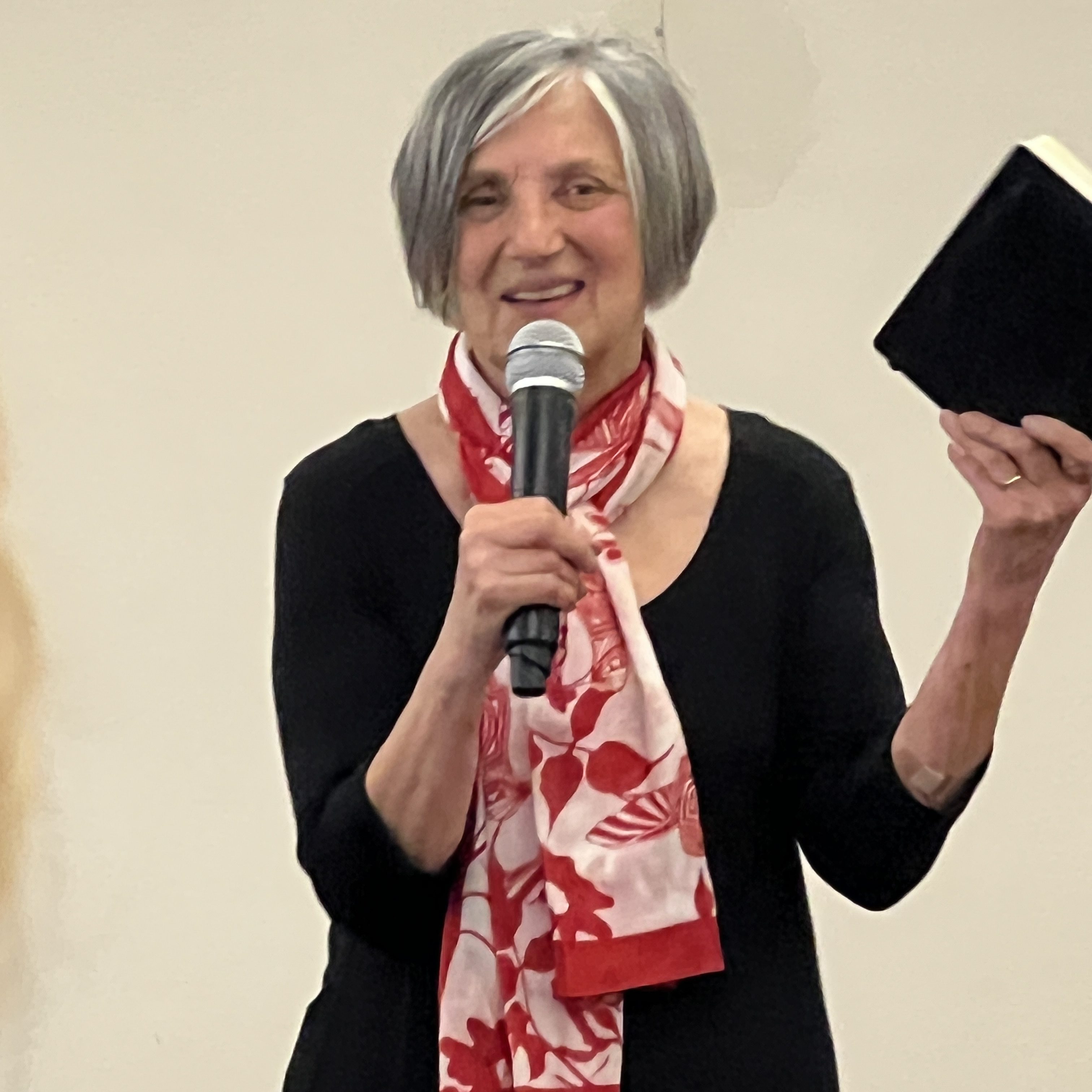
For its latest edition, Thorn and Bloom Magazine chose the theme “Radical Joy We Cultivate”. I immediately submitted this essay to the editor. “Moxie” was written years ago and it concerns a particularly joyous time in my life, when I stopped writing a doctoral dissertation and became a clown for a short time. It’s all true, but I changed a few names to protect the innocent.
Ironically, my career as a clown coincided with a sad and difficult time in my life, and maybe that’s why the joy felt even more pronounced.
If you could use a little joy, please read this amazing issue here:https://thorn-and-bloom.com. The essay appears below:
Moxie
I was supposed to talk to a Mr. Freddy about a job. I had dragged myself to the other side of town, far from the university, to the offices of Laugh-A-Gram, a small storefront entertainment agency wedged between a falafel joint and an H&R Block. In the dusty front window, there was a clown mannequin, a fluffy pig costume, some spilled confetti, and a couple of rubber chickens. Inside, the air smelled of latex balloons.
A friend, hearing that I was looking for extra work, had encouraged me to apply. She assured me that no experience was necessary, but I found myself hesitating at the door. This was not my kind of place. I was a graduate student who spent hours ensconced in a Gothic library, my nose in various 18th century tomes. At the same time, I worked part-tine as an adjunct French professor at a third-rate local college. I was a serious, cultured person, the kind of human being who conjugated irregular Latin verbs to put herself to sleep.
I found Mr. Freddy at his desk, yelling into a telephone. Behind him, a jumble of wigs, props, fuzzy suits, and huge polyester animal heads hung from metal racks. When he put down the phone, he looked me over and shook his head.
I started to introduce myself, using my friend’s name as a reference.
Freddy interrupted with a snarl.
“You a teacha’ or a student?” he asked.
Maybe my face conveyed a sort of schoolmarmish scowl.
“Kind of both,” I said.
Freddy leaned back in his swivel chair. He narrowed his eyes.
“So you’re used to public spitting, right?” Freddy asked.
“Spitting?” I asked, slightly bewildered.
I looked at Freddy’s face. He was now grinning broadly. I realized that he was testing me.
“Of course, I’m used to public spitting,” I boasted. “Once I spit in the eye of a student in the back row just by saying the word Robespierre.”
‘So let me guess. You can’t juggle, you can’t sing, and you can’t pratfall,” said Freddy.
We went on like this for a few minutes. Was this an interview? Or was Mr. Freddy just a little bit crazy? I couldn’t tell. Now and then, Freddy would hand me a prop, an “exploding” mustard jar or a fly swatter as large as a tennis racket. If I thought too much, I’d come up with nothing. My cerebral side got in the way. But if I let myself go, I could tap into absurdity.
Occasionally we were interrupted by a phone call or the comings and goings of a costumed Marcel Marceau or a Raggedy Andy. As I listened to Freddy’s interactions with his employees, I got the impression that he thought of himself as a show business mogul, a Ziegfeld or a Barnum. It became clear, however, that Laugh-A-Gram’s scope was largely limited to providing costumed characters for local birthday parties, company picnics, retirement homes, and business conventions. The Commedia del Arte it was not. In those days, balloon delivery was a big deal as well, with most offices and institutions open to welcoming a costumed stranger, with no security checks.
As Freddy and I chatted, I could feel him measuring me with his eyes, but not in lurid way. At five foot two, I was small enough to portray a duck or Little Bo Beep. I was also limber enough to function as a mime or a dancing penguin.
“I go by my gut,” said Freddy at the end of our meeting, “I think you’ve got the necessary moxie.”
I wasn’t sure what moxie was, but we shook hands.
Freddy immediately started to find gigs for me. A singing telegram at a wedding, a walk-around dressed as an ostrich for an insurance convention.
“We could use a Wise Owl for a Bar Mitzvah. Can you do it? Saturday afternoon?” he’d ask.
I was almost always available. Newly divorced women often don’t have much of a social life. On the weekends, or sometimes between classes, I was more than happy to earn a hundred bucks for a few minutes “work”. Especially work that was joyful and light-hearted.
“Pick up the costume around noon. Be on the set by 1:00 PM,” Freddy would say.
When he spoke to me, Freddy always made it sound as if he were talking to some movie star of old, Lucille Ball or Betty White. As if I were headed off to Universal Studios instead of the local VFW hall.
“Right, boss,” I’d say.
“Gotta run. The bookings are coming in fast and furious. A lotta great shows in the works,” Freddy would say as he hung up the phone.
I didn’t mind Freddy’s pretense of greatness. If anything, his illusion that Laugh-A-Gram was Hollywood added to the charm of the job.
Working at Laugh-A-Gram became a kind of Get Out of Jail Card for me. An escape from reality. In those days, I felt burdened by my responsibilities as a single mother, the stresses of teaching and fulfilling grad school requirements, the aching loneliness of a newly divorced woman. I was bitter that my husband had left. My feelings of having failed at marriage clung to me like smoke. I’d get dressed quickly in the morning in zombie-like fashion, throwing on nondescript clothing and sensible shoes so I could run from my child’s soccer game to the Stop&Shop, from a meeting with my thesis advisor to a faculty workshop.
My regular job provided little in the way of fun. While I thought I would love teaching, I found those particular college students quite dull. Or maybe it was just me. In any case, the curriculum at that institution was outdated and set in stone. It was hard to muster enthusiasm for explaining Alexander Dumas and La Dame Aux Camélias to a bunch of twenty year olds who didn’t know a camellia from a beer keg.
But the longer I worked at Laugh-a-Gram, I realized that the job was providing me with a chance to re-discover the imp that was part of my childhood. Once upon a time, I had been silly, mischievous, playful. But that joy had been scrubbed out of me by the Ivory Tower, or maybe just by growing up and abutting adult life. Laugh-a-Gram was the ultimate in make-believe. I could forget my worries when I took on the persona of Mrs. Duck. And there really were no rules. Freddy expected me to write my own material or come up with my own set of gags, a challenge that was quite a bit more relaxing and liberating than writing a doctoral thesis.
If I felt like singing, I sang. Even though I sing off-key, no one ever complained. If I felt like blowing a CEO a kiss, I never hesitated. If I wanted to see if I could still do a cartwheel, nothing stopped me from trying it in the hallway of the Olds Folks Home, causing the residents to squeal or gasp with pleasure.
The motto of Laugh-A-Gram was Put A Smile On It. These words were stamped on all Freddy’s contracts, and he usually repeated the slogan while sending me off to a new gig.
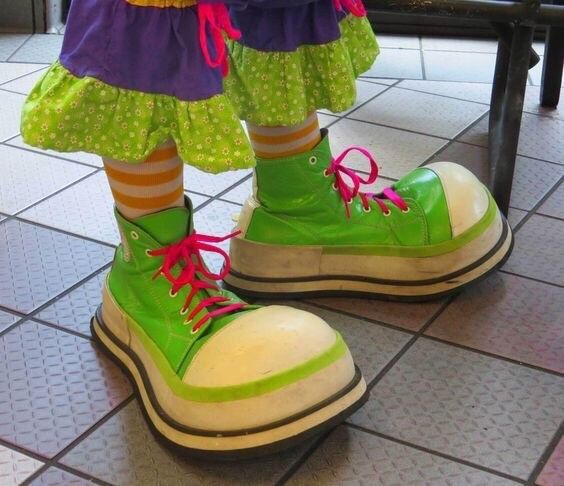
I soon learned that if I managed to leave an audience with really big smiles, the tips would be really big as well. But my greatest pleasure didn’t come from the money. It came from bringing something to ordinary people, many of whom were weary, bored, discouraged, or just moping along. Sometimes I’d park my car, change from my regular shoes to my polka-dotted clown shoes or my chicken feet (you can’t drive in oversized shoes) and start sashaying over to an office building where a person working in a brokerage firm on the 15th floor was about to get a surprise. Along the way, on the street, people who were just plodding through their day would see me. It was impossible not to see me. A clown or animal costume stands out in a throng of business types wearing three piece suits and polished Cole-Haan shoes. It was rare not to catch their faces changing. Sometimes a full toothed smile, sometimes a smirk, sometimes a grin as if they didn’t want to get caught enjoying a memory of childhood or a vision of the absurd.
Sometimes I’d interact in a parking lot just for the heck of it. I’d do a little mime thing, or hug a light stanchion, or simply greet pedestrians with an exaggerated bow. The public’s reactions made me happy.
Occasionally people would hand me money out of the blue, in appreciation. I’d be leaving a Bar Mitzvah party and somebody’s uncle would come running after me, thrusting twenty, thirty, fifty bucks into my white gloved or fuzzy hands. “You made the rabbi laugh,” they’d say, or “You were the icing on the cake.”
That kind of payment felt different from any other money I’ve ever earned. My professional salary was always direct deposited. I had no physical relationship with it. But those Laugh-A-Gram tips were warm and alive. They came out of someone’s pocket, reeking of Chiclets or Altoids, orange peels or tobacco, engine oil or laundry detergent. I started to think of those tips as funny money, earned with a kind of joy in my heart.
I derived a lot of pleasure from my moonlighting job, even though some people thought this line of work was “beneath me.”
“Surely you could find further work in your professional field,” a relative suggested. “Have you tried looking in The Chronicle of Higher Education?”
But I needed Laugh-A-Gram at that point in my life. Plus I was never bored. This kind of low-level performing required spontaneity and creativity. I appreciated the opportunity to live lightly. to cultivate laughs, not erudition.
One day, Freddy called with desperation in his voice.
“The bookings are coming fast and furious,” he said. “Could you do me a favor and work a Firemen’s Association party? Like tonight? I know it’s last minute. But it’s just fifteen minutes of clowning. That’s all.”
“Sure,” I said. “You mean just a regular clown? For families? Red nose, big wig,. Do a few gags, a little stage business?”
“Yeah, yeah,” said Freddy, in his usual frenetic manner. “They have a gap before the main act. You’ll keep ‘em happy.”
“Put a Smile On It,” he said, as he hung up.
I pictured a hotel ballroom full of firefighters and their families, maybe a child-friendly singer with a guitar as the main attraction.
When I arrived at the venue, I saw swarms of muscled men tottering around in the lobby, as if they were on a swaying ocean liner, holding onto the walls for support. I didn’t see any female firefighters.
A few minutes later I walked onto the stage. The audience was slouching on folding chairs placed around tables decorated with a miniature fire truck, an American flag, and a tray of raw vegetables and a creamy dip. There wasn’t a child in sight. The room smelled of booze and ranch dressing.
I had been planning some nonsense, pretending to put out a fire. I’d even brought along a tin bucket. Now I needed to switch gears quickly.
I strode back and forth across the small stage, swinging my bucket. My mind was racing. Surely I could come up with a bit of adult fireman-oriented humor. Something about hoses, maybe.
“What the hell is this?” came a voice from one of the front tables.
I ignored the heckler and continued my patter.
“I thought we were getting a stripper,” shouted another voice.
One man started to beat his palms against the tablecloth. Others joined in. The pounding caused a couple of the miniature fire engines to slide off tables. Drinks spilled. Someone started booing.
Suddenly, I felt something spongy hit me on the side of the head. The firemen were throwing the cherry tomatoes. Little flecks of creamy dip splattered my wig.
“Where’s our stripper? Where’s our stripper?”
The firemen were in an uproar. I felt I had no choice but to abandoned ship. Stumbling in my ridiculous shoes, I headed off stage. I ended up dropping the tin bucket and leaving it behind as I made my way out of the building. I felt humiliated, but I wasn’t hurt. Most of all I feared facing Freddy. I suspected he would upbraid me for failing to leave the audience laughing.
But he didn’t. He admitted that he had misunderstood the nature of the event.
“I screwed up,” he said.
He patted my back and assured me that he knew all about performing.
“Sometimes you bomb,” he said. “So whadya do? You pick yourself up and start all over again. That’s show business. That’s life.”
Eventually I said goodbye to Freddy and pursued a full-time academic job.
But I discovered that performing for Laugh-A-Gram gave me the confidence to bring my natural, innate humor into all my work, into all my interactions. I stopped teaching college students and discovered that zany energy works well with Middle Schoolers. I never worried about making a fool of myself – I’d already faced a room full of drunk firemen, I oould do anything. In time, I got appointed to several leadership positions at independent schools, largely because I never feared giving a speech and I could think on my feet, although, by then, I refrained from doing cartwheels. I could face an audience of trustees with self-assurance and a smile.
Joy is there for the taking. You don’t need oversized shoes, just a little imagination and a dose of moxie.



 Gabriella Brand
Leave a reply to gkarlssoncfe0c50e82 Cancel reply