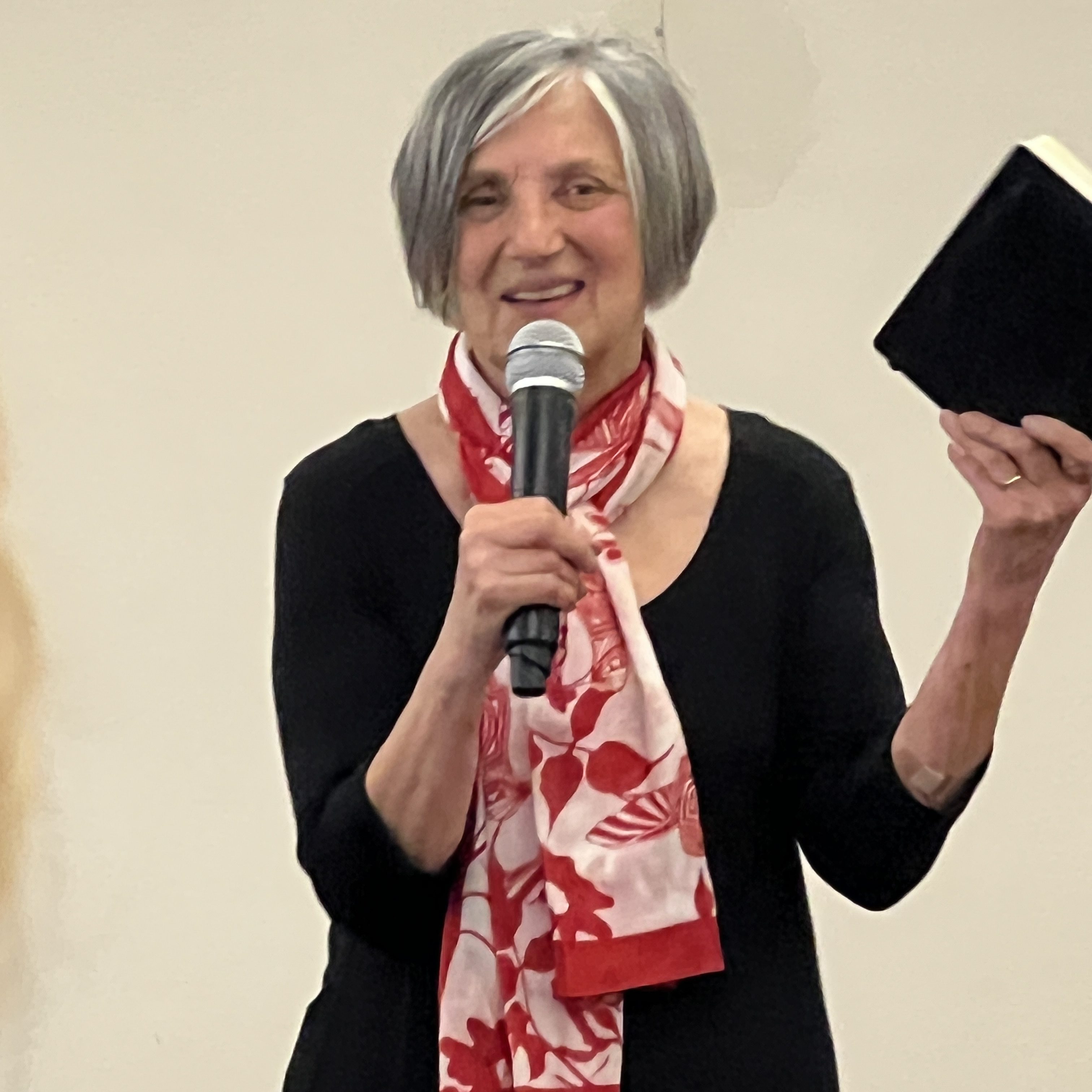
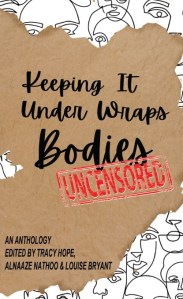
I am delighted that my essay ‘Stache appears in this beautiful new anthology “Keeping It Under Wraps: Bodies” edited by Tracy Hope, Alnaaze Nathoo and Louise Bryant.
This collection, the third one in the Keeping it Under Wraps series, was published in England, although all three editors live in Switzerland.
The editors write: With the constant stream of unrealistic and dangerous standards bombarding us from all sides, we can only draw one conclusion. Despite everything our bodies do for us, they are not as they should be, and many of us battle our entire lives chasing an ever elusive end goal. While we chase the impossible, we avoid sharing about our disabilities, chronic illnesses, or our perceived flaws or deformities because we feel alone, or we don’t want anyone to feel uncomfortable.
These are real stories, told with humour, love, self-awareness and frankness, shared so we can all feel less alone in our skins. To show each other that we are all, in fact, more than good enough.
With contributions by:
Gabriella Brand
Natasha Cabot
Catherine Cronin
Iris Leona Marie Cross
Sarah Lyn Eaton
Eirik Gumeny
Hillary Jarvis
Beth Ann Jedziniak
Adin K
Premalatha Karupiah
Frauke Kasper
Bruce Loeffler
Matt McGee
Jessy Mijnssen
Aiofe Osborne
Heather Purlett
Nancy Rechtman
Kay Redrup
Julia Rudlaff
KT Ryan
Adrian Slonaker
Bex Thorp
Meredith Wadley
Sarah Wirth
Majini Ya Mombasa
Available now on Amazon in several formats, and soon in paperback at your booksellers.
‘Stache
There are two kinds of girl mustaches – the funny kind and the shameful kind. I’ve had both. The funny mustaches are made out of milk or ice cream. I sported them above my upper lip at various happy times throughout my childhood, sometimes when I was down at the Dairy Bar with my friends, our bicycles thrown to the ground, each of us holding icy vanilla milkshakes in tall, waxy containers. We’d be laughing because Grade Five was over and the summer was long and ice cream mustaches were inherently humorous.
But the other kind of mustache wasn’t funny at all. Mine first appeared sometime towards the middle of Grade Six. It was the harbinger of puberty and boxes of Modess.
A boy in my class pointed it out.
“Freak show, freak show,” he thrust his finger at my upper lip and sneered.
I must have looked confused.
“You’ve gotta mustache, like the Bearded Lady, “ he explained.
I’m sure I blushed, but with my olive complexion, a gift of my Italian ancestors, perhaps the blush wasn’t so obvious.
A few other boys gathered around.
“Gabi’s got a mustache, Gabi’s got a mustache,” they started to chant.
By now I was barely holding back tears.
We were on the recess field. Miss Pederson, our teacher, was standing just few steps away from us. She was keeping one eye out for the younger kids on the swings. Blond and blue-eyed, Miss Pedersen’s skin was as pale and delicate as a Scandinavian winter sky. She was not the sort to have any kind of mustache. Ice cream or otherwise.
She came over and put her arm around me. She was young, with a gentle way about her.
“It’s okay, Gabi,” she whispered.
The teasing boys had run off by then, but she shouted for them to come back. She insisted that they apologize.
I was grateful to her, even as I could feel hot embarrassment moving into my belly. I hoped I wouldn’t throw up. I sucked in my sobs.
We formed a little circle: Miss Pedersen and I, plus the guilty boys. But soon other kids stopped playing games and jockeyed for a place near us so they could hear what was being said.
No doubt Miss Pedersen must have thought she was being helpful by giving a thorough explanation of feminine facial hair. She went on to talk about Grade Six girls growing up. Then she mentioned different ethnicities and how people of Italian descent often have dark hair. And how that hair is often VISIBLE on their upper lip.
“I’ll bet even Gina Lollobrigida might have some hair on her face,” she said brightly.
This was in the late 1950’s and the sexy Italian movie star was a household name.
I wanted to die.
That night I looked at myself carefully in the bathroom mirror. The boys were right. I was a freak.
Bristly black hairs were growing like fungus over my upper lip. If I turned in either direction, the mustache looked smudged, the way my math paper looked if I erased an answer over and over. I tried pulling the five or six wiry hairs out with my fingers, but I couldn’t get a grip on them.
There was no question about it. I would never go to school again. I’d have to stay in my room, in my bed, with the covers over my head. Perhaps the hairs would grow so long that I’d have a handlebar mustache, like Buffalo Bill.
Mother cajoled me out of bed the next morning, assuring me that I could find products which would take away my unwanted hair.
“Forever?” I asked.
“No, just for a short time. Hair grows back.”
She tried to tell me that I was nowhere near Freak Show status, but I didn’t trust her judgment. She didn’t have a mustache herself. My dark hair and eyes and skin had come from Papa. Mother had light brown eyes and auburn hair. Her complexion was fair. What did she know about grooming olive-skinned girls who looked like Groucho Marx? Who were dead-ringers for the Bearded Lady?
That afternoon I got on my bike and pedaled into town. All the hair-removal products on the shelf at Bower’s Pharmacy seemed alike. There was Nair and Neet and a few others. I picked one in a pink box. The model on the box looked serene, with a face as smooth as a porcelain sink. Her bare arms held a bouquet of pink roses strategically across her chest like a naked Miss America.
I pedaled home and rushed into the bathroom. I stripped off all my clothes and took a quick look in the mirror. I was an ape. A veritable ape. There was no question about it.
Without reading all the directions on the bottle, I took a wad of cotton balls and dabbed the cream liberally on my upper lip, down my sideburns, around my neck, up and down my arms and legs. I even found one or two hairs on my toes and dotted them with the white goop, although I left my newly sprouted wisps of public hair alone.
Soon a strange sour odor filled the bathroom. I sat down on the covered toilet seat and waited. The swans on the wallpaper seemed to flutter, float, and drift off before my eyes. I was feeling light-headed, but I figured I had to wait patiently for the product to do its job.
It wasn’t long before my entire skin began to itch and burn as if every hair follicle were on fire. Did the stinging mean that the product was working really well?
I waited some more, breathing hard, my eyes watering.
Finally I wiped off the cream and I saw little black hairs on the washcloth, scythed down by the toxic lotion. I looked at my forearms. They were the color of strawberries, but there was no hair. I examined my thighs. No hair. And my upper lip, while swollen, was as bald as a baby’s bottom.
I threw on a bathrobe and ran downstairs to show my mother.
“Oh, you did this yourself?” she asked, wiping her hands on her apron. “I was going to help you.
I thought she would be proud of me. But she looked slightly alarmed.
“You look awfully red, honey. I think you’re having an allergic reaction.”
She pulled me over to a window so she could get a better look.
By now my skin had erupted in thick scarlet patches, peeling like a boiled tomato.
She quickly made some cool compresses and covered me from head to toe. My upper lip looked bulbous and raw.
Mother asked me how much hair remover I had used.
“The entire bottle,’’ I answered.
The swelling eventually went down and within a few weeks my little mustache grew back. Mother suggested I pluck it with tweezers. However, keeping my errant hairs under control was like keeping dandelions from taking over the front yard. I’d pluck one and six others would grow in its place.
In high school, I submitted to electrolysis. The brusque technician who first treated me assured me that I was not, by any means, her worst case.
“You have just a dusting of growth,” she said.
Then she proceeded to zap each hair with a little needle that made a buzzing sound like one of those anti- mosquito machines.
“This procedure will permanently remove your hair,” she assured me.
It didn’t.
At university, I turned to waxing. I’d go to a fancy salon and the aesthetician would lead me to a private room, away from the other clients. She’d paint my upper lip with hot wax and then rip off the hairs with a sticky strip, like a band-aid on scraped knee. I’d look clean-shaven for a short time, like a young recruit, but then I’d have to return to the battlefield.
As I grew older, I got used to taming my ‘stache. After a pregnancy or two, it became a mere shadow of its former self and I rejoiced. But then, with age, the lip hairs returned slowly and steadily, like mold taking over the bathroom shower.
I’m still doing battle. I tell myself it’s silly, but I can’t stop. I find that, in spite of advances in feminist thinking, hairs on a women’s upper lip often remain a subject of mockery and derision. Something that just doesn’t belong on a female face. Whether this assessment makes sense or not, it’s a view I’ve internalized and can’t completely shake.
In fact, many of the dark-haired women I know find themselves running on the endless hamster-wheel of mustache removal.
I’m thinking of a young acquaintance of Greek origin who wears a buzz-cut. She eschews traditional feminine clothes or make-up, but she still waxes her mustache.
Is this just a North American beauty concept? I don’t think so.
I have a raven-haired friend originally from the Middle East who is fastidious about controlling her mustache and unibrow. And when I visited India, I was surprised to see lines of women waiting to be “threaded” by the village expert.
Actually, my discovery of threading has somewhat changed my relationship with my mustache.
My own current threader is from Pakistan. Her name is Deeba and she has an easy-going acceptance of hairy upper lips, and of dark body hair in general. All her daughters have mustaches too, or they would have, if Deeba herself didn’t stand over them with her slippery thread and coax those hairs to surrender.
I like going to Deeba. Her place is lively and comfortable, with chatty friends and customers coming and going, plump pillows on the couch. When I go there, I feel as if I am no longer alone with my dark pelage. I’m part of an international community of dark-haired women on whom mustaches grow naturally, the way eggplants or mint grows in a garden.
I enjoy lying back in Deeba’s comfy chair, under the bright light, and puffing out my upper lip with my tongue. This creates the stretched surface necessary for the spinning thread to catch the smallest of hairs.
Deeba mows down my mustache with a few brief strokes, like a landscaper with a weed-wacker. It’s all over in two minutes and I thank her, and I give her a little bit of money and she puts her arms around my shoulders and blesses me.
“Go in peace and return”, she says, and I do.



 Gabriella Brand
Leave a reply to Ira Mickenberg Cancel reply