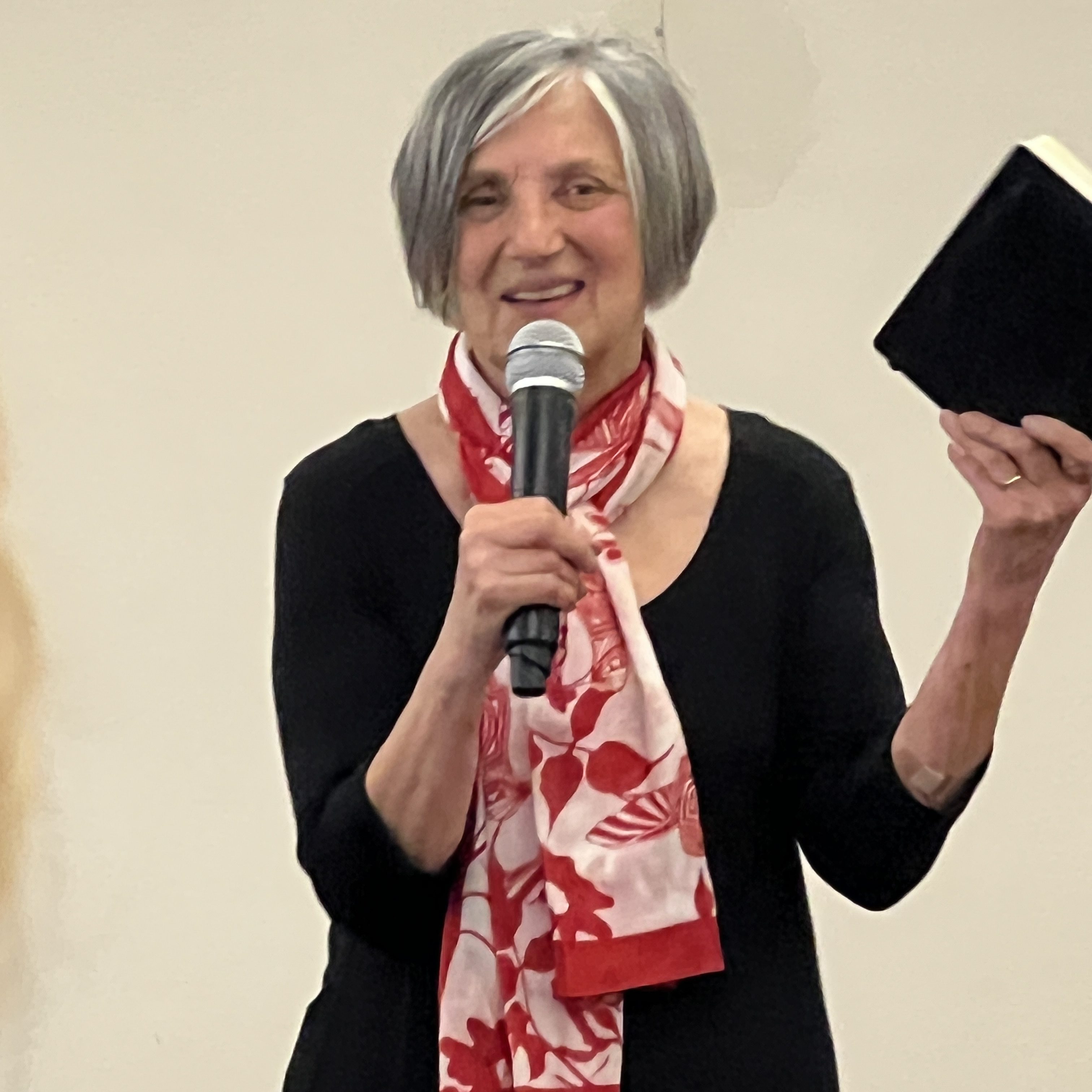
My essay ”On the Shelf” describes my experiences in Greenland (prior to the Covid pandemic). It’s a reflection on climate change, personal aging, and maybe a little bit more. I am delighted that it was chosen for the inaugural issue of the literary journal Adventures in Ideas.
I love the premise of this beautifully composed publication. As the editors say:
“Because travel is as much an intellectual affair as it is a physical one, we believe that travel writing is most enriching when it engages with the world of ideas.”
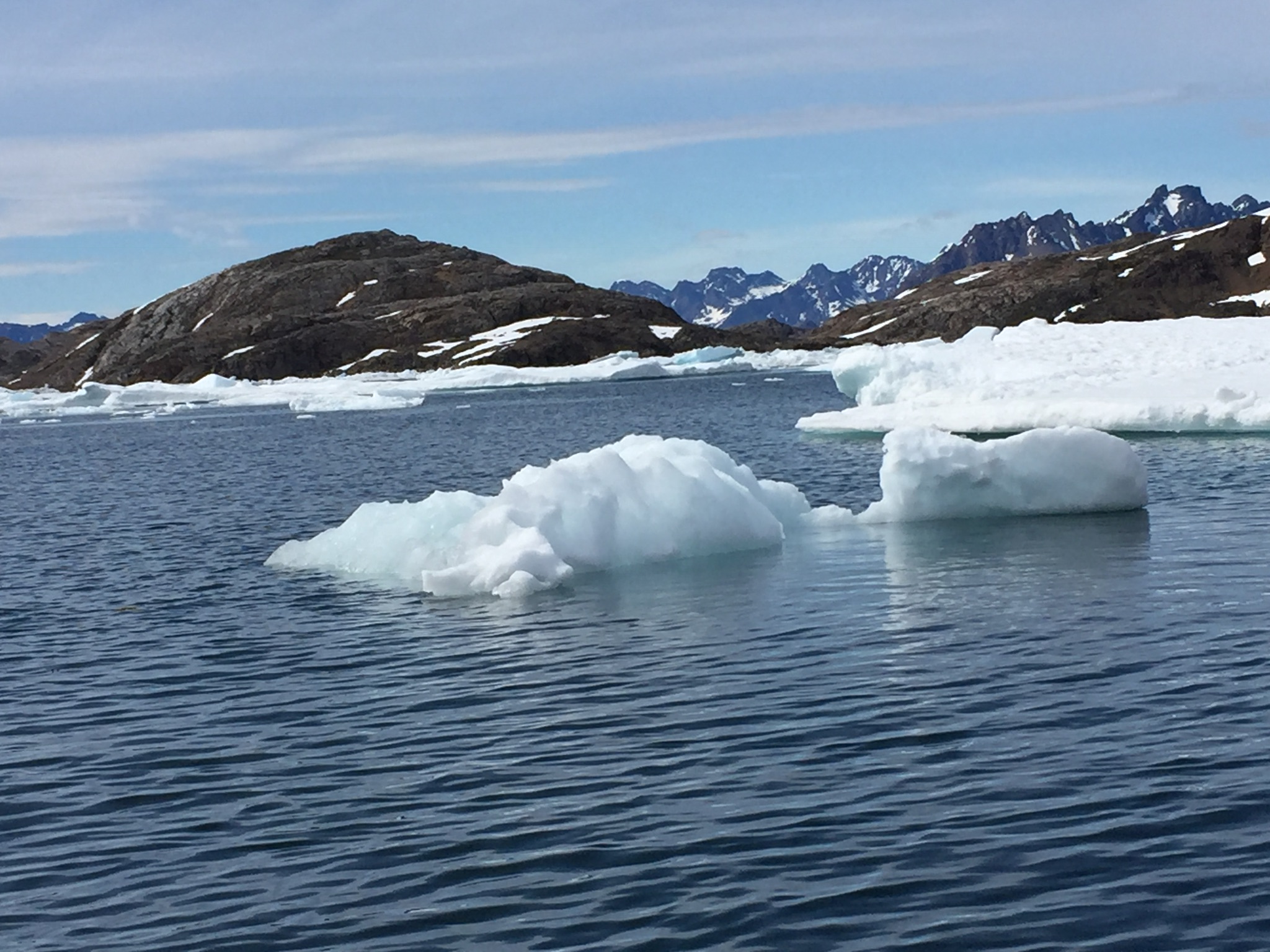
As the propeller plane approaches Kulusuk, I press my face to the window. The blue sea is dotted with mounds of floating ice like meringue on a pie. At first the massive chunks all appear starkly white, but then I notice the colors swirled inside them: cerulean, aqua, teal. I know that some of these icebergs are as tall as skyscrapers, but it’s hard to make comparisons when there are no buildings in sight. In the distance, jagged mountains rise up like a monster’s teeth, hundreds of them. Most are snow-covered, but others are chocolate brown and rocky.
I had always imagined coming here. Even when I was a child, I was fascinated by the size and the mystery of a place called Greenland that was anything but verdant and leafy. I didn’t yet understand the distortions of a Mercator projection, but no matter what map I looked at it, this area always seemed immense. Geography books talked about floes and glaciers, fjords and ice shelves. What adventurous child wouldn’t want to climb on a shelf made out of ice?
Now, I’m finally here as a mature adult. A very mature adult. A grandmother, even. The spunky kind who is not afraid of wearing crampons and who can fit all her travel gear into a rucksack, but a grandmother nevertheless.
I’ve chosen Greenland out of curiosity, that’s for sure. But I’m also here to face change. On the one hand, the massive Greenland ice sheet is melting all too quickly, with irrevocable consequences for the planet. It will never be the same again. On the other hand, I’m no spring chicken. My hair is turning gray. If I want to experience this unusual place, I can’t wait much longer.
I’ve brought along an eleven-year-old grandson. The bookish kind who reads a lot, with a well-honed imagination.
Some of my friends think I’m nuts. Greenland? Why Greenland? There’s nothing there.
One acquaintance suggests I do Alaska instead, on one of those grandparent-grandchild tours. But I crave Greenland. And I certainly don’t want a tour. That’s not my style. I’ll make my own frugal arrangements as I usually do: walking as much as possible, hiring a guide when needed, and determined to meet local people.
Now, as the plane descends and the expanse of jagged coastline unfolds before us, my grandson almost drains my phone battery taking videos. We both agree that it feels as if we could reach down and scoop up a piece of the globe. We’re coming into Eastern Greenland, not the North Pole, but emotionally, we’re at the top of the world. As far as we can see, there’s nothing but ice and ocean, mountain and sky, until finally we spot a few small houses and a gravel tarmac.
When we touch down at the military style airport, the grandson notes the latitude, posted below the WELCOME TO KULUSUK sign: 65.5708N and -37.1208 W.
He quickly calculates the distance to the North Pole.
“We’re pretty far south, aren’t we?” he asks, sounding disappointed.
I remind him that Greenland stretches its icy spine all the way up to Kaffeklubben Island. That’s the 83rd parallel.
“We’re 68 miles or so from the Arctic Circle,” I say.
He tells me I sound like one of his teachers. This particular child soaks up facts easily, but I make a mental note to go easy on the school-marmy lectures. Let him uncover this place at his own speed, I say to myself. So he can remember it forever.
“Are we going all the way up to that Kaffee, Coffee Club whatever?” he asks, hopefully.
“Nope,” I say, hoisting my only baggage, an old Osprey rucksack, onto my back.
He does the same and we set off to walk a half mile into Kusuluk proper, our gateway to Greenland. It’s home to 240 people, but there’s a school and a Lutheran church and a small store.
I see only two other passengers from our flight who seem to be following the path into the village. Perhaps they’re also heading towards the Kulusuk “hotel”, a former U.S. military Officer’s barracks modestly converted into tourist accommodations. I assume the handful of passengers who boarded with us in Iceland are taking helicopters to other destinations.
The grandson starts running ahead, as if he’s been here before, in another life. He’s a city child, and not a particularly courageous one, but something about setting foot in Greenland has sparked his sense of adventure.
“It smells so good here,” he says, leaping onto the boulders that line the path.
And it’s true. The air feels and looks pure and clean, as if someone had washed it out in the briny sea, rinsed it, and hung it up to dry.
Perhaps he’s also enjoying the rare pleasure of stepping out of an airplane and having his feet touch soil, not carpet or industrial flooring. Just packed dirt. No jet bridge. No moving sidewalks. Full nature all around.
We walk slowly along stopping every few minutes to take in the views on all sides. The natural beauty is far more impressive than I had even imagined: the undulating land, the little skerries – dots of rock poking up here and there in the sea – the distant glaciers, and the never ending parade of ice in the water.
I point out the brown ribs of the sacred mountain, Qalorujoorneq, jutting out behind us through the sparse snow.
“Are there any roads in Greenland?” he asks after a while.
“No roads connecting one settlement to another. That’s why people take helicopters or ferries or dog sleds.”
“Cool,” he says. “This is gonna be fun.”
We hear footsteps on the gravel behind us. They belong to the pilot and the two attendants from our flight. The attendants have exchanged their heels for walking shoes. They tell us that they have a few hours before they will fly back to Reykjavik so they’re going to have a luncheon picnic.
“We brought our own goodies!” says one of the crew, indicating the stuffed cloth shopping bag she and her colleague are carrying.
“It’s a good day for a picnic,” I say.
“Perfect,” says the pilot.
It’s about 36 degrees Fahrenheit, and the sun is high in the sky.
Did I mention that we’ve arrived in Greenland in mid-June? We’ll have at least twenty-three hours of daylight in this season.
Overhead a bright red helicopter chugs across the azure sky.
The flight crew head for their picnic spot down a small ravine and we stick to the path.
Suddenly, from out behind a boulder, two young Inuit boys emerge without a word. They have shy grins on their faces. I’m pretty excited. I feel sure that these kids must have seen my grandson walking along on the path from the airstrip. I’m sure that they would never have come forward to meet just an old lady tourist. The draw is the presence of a foreign child.
I ask their names, trying a little Danish and then a little English. I don’t really get their answers. I ask about ages and they tell us, using their fingers. They are one year older than the grandson, but they look younger. They have ruddy faces and short torsos. Both are dressed in the universal youth outfit: sweat pants, sneakers, and hoodies. One wears a beanie cap on his head. If it weren’t for the language barrier, they could my grandson’s classmates.
The native boys alternate between leading the way and following at our heels. Jabbering away in a dialect of Greenlandic, they are in constant motion. They remind me of puppies.
I can see the village houses now – small, boxy wooden dwellings, all painted bright red or yellow or blue, like tins of Danish biscuits.
We’ll soon learn that few, if any, of these colorful houses have running water. There are two communal washing machines, though, and while we are visiting, they will be in constant use. Women, both old and young, will lug plastic laundry baskets up and down the rocky knolls.
Life will be different in the capital, Nuuk, which boasts 17,000 people, a university and a few gourmet restaurants, but small settlements like Kusuluk have their own challenges, both physical and social.
Wandering near the houses, we hear the whines of sled dogs who are tied up for the summer. They lie on the ground, scruffy and bored, their fur matted like a worn rug. This year- and for the past several years – they’ve stopped supplying transportation even earlier than usual because the straits became navigable by boat. The Torsuut Tunoq Sound, which separates Kulusuk from the uninhabited Apusiaajik island, actually opened up by May this year. It used to stay frozen until July. As we walk, we can hear the buzz of small motorboats out on the water.
Soon the boys and I come upon a graveyard. I’m unprepared for the shock of seeing pink roses and purple hyacinth beside the graves. Has our warming planet come to this? Flowers pushing through the permafrost?
Amazed and puzzled, I run up the knoll to get a better look with the grandson and the boys tagging along.
I find twenty or thirty graves each marked by a wooden cross and clusters of plastic flowers. Aside from the artificial decorations, I appreciate the simplicity of the place. No statues, no pretentions. I assume there aren’t coffins buried in the hard ground, just bodies lying underneath basic cairns. I think to myself that I’d like to be buried like that someday. No embalming chemicals. Just my body in the earth.
We seek out dates or names on the crosses, but there are none. I explain to my grandson how most Inuit people, even those who practice Christianity, don’t believe in identifying a grave. Names must be kept alive. When someone dies, his name is given to someone in the next generation so that the spirit of the dead person keeps on living.
The grandson looks skeptical, but I remind him that he, too, is named for a grandfather, fortunately still living. And his sister was given my father’s last name as a first name.
“We keep the past alive too,” I say, “But in a slightly different way.”
I poke around among the graves and think, respectfully, about the former hunters, midwives, and shamans who might be lying under the phony foliage.
The Inuit boys take off while we’re visiting the graveyard, but soon join us again when we’re back on the main path.
We all walk around near the tiny harbor, getting a closer look at the flotilla of ice chunks that are drifting out to sea. A few men with leathery cheeks and unzipped jackets are hanging around the dock.
The two boys seemed puzzled by our attraction to the vistas they see every day. They immediately run off again. We have no idea why. But in a few minutes they return with some Danish coins and a whale’s tooth. The grandson spontaneously offers chocolate bars and dried apricots from his rucksack. I’m proud of him for thinking immediately of reciprocity.
The youngsters poke at the wrinkled orange fruits with suspicion, but eventually they pop them in their mouths and chew and pucker their lips and giggle. They save the chocolate for later. The world feels very small and safe.
Now, using gestures, our new friends lead us further up a small hill. We come to a trampoline, of all things. The metal contraption is wedged between two small houses. It is jerry- rigged in places, but it looks serviceable. I wonder if it was left behind by the U.S. forces in the 1950’s, when they occupied this island setting up the Defense Early Warning System.
The grandson gives me a look of incredulity. Neither of us ever expected to find a trampoline on the permafrost, but then again, why not? He gamely takes off his shoes and joins in the jumping. The Kulusuk boys have a certain Cirque du Soleil grace about them. They can easily somersault and flip over, springing back up off their hands. The grandson’s participation is more cautious, but he looks comfortable. He could be at home, in his own yard, except for the howling of the sled dogs.
While the boys laugh and bounce around in their socks, -the perfect image of youthful energy- my thoughts turn back to the graveyard.
I find myself thinking about the experience of growing old. Not just in Kulusuk, but anywhere on earth.
It’s not an easy trip, this ageing thing. On the one hand, you can’t help but think about the world you will eventually leave behind. And those thoughts inevitably lead to questions about the environment. What planet will my grandchildren inherit? Will Greenland really become green? Will Manhattan be tropical? What will the air be like? The heat? The food supply?
At the same time as you’re pondering the global issues, you can’t help thinking about your own mind and your own body. Their fragility. How much longer will I have this gift of being alive? Of being able to experience this diverse and beautiful world?
I think about my own life for a minute and a comforting image slowly comes to mind. I start to picture myself as a human ice shelf, soon to weaken, break off, and blend into the sea. I think about death and I can see myself on a natural journey from youth to old age, participating in one of the ongoing processes of the earth.
The boys continue to play on the trampoline. I listen happily to their whoops and laughter. The wind ripples the fjord.
I breathe in deeply and fill my lungs with brisk Greenlandic air. It’s nearly the longest day of the year. The sun will stay high in the sky for hours and hours, as if it were trying to fool me into thinking that time is standing still.
You can read the essay here:



 Gabriella Brand
LET US KNOW WHAT YOU THINK